


Singapore homes face a specific combination of health risks that most cleaning guides ignore. Outdoor humidity sits at 80 to 85% year-round. NEA confirmed that 65% of all Aedes mosquito breeding sites in 2025 were found in homes. Children bring bacteria from school surfaces into high-touch zones daily. And post-COVID awareness has shifted how families think about surface hygiene.
But here is the other side: over-cleaning with harsh chemicals causes its own problems. Bleach residue on food surfaces is more dangerous than ordinary surface bacteria. The WHO linked triclosan-based products to antibiotic resistance in 2016. Most surfaces in a Singapore home do not need hospital-grade disinfection.
The answer is a tiered schedule that targets the real risks. We call it the Rule of Thirds: monthly, quarterly, and annual tasks, each matched to actual health vectors rather than surface appearances.
Why Singapore Homes Need a Different Cleaning Standard
Quick Answer: Singapore's 80-85% mean humidity, year-round dengue season, and school germ cycles mean a standard weekly wipe-down misses the real health vectors. But daily disinfection of every surface is equally unnecessary and can be harmful. A monthly, quarterly, and annual schedule targets where bacteria, mold, and mosquito larvae actually breed — without overkill.
Singapore is the only developed country where dengue is endemic year-round. In 2025, NEA inspectors conducted over 565,000 mosquito checks and found 20,469 breeding habitats. 65% were inside homes. The top five breeding spots: flower pot trays, pails, ornamental vases, canvas sheets, and plants with hardened soil. All are common in the average HDB flat or condo.
Mold is the second vector. Singapore's humidity regularly exceeds 80%, but mold growth begins at 60% relative humidity. Most Singaporean homes sit naturally above that threshold, particularly in bathrooms, under mattresses, behind wardrobes, and inside aircon ducting. Mold can establish on bathroom grout within two to three weeks of consistent moisture without scrubbing.
The third vector is school-age children. Kids aged 4 to 12 interact with dozens of shared surfaces daily. Bacteria transferred from school bags, shoes, and hands reach doorknobs, light switches, and remote controls within hours of arriving home.
Over-sanitising does not fix any of this. Products containing triclosan are linked to antibiotic resistance (WHO, 2016) and most household surfaces harbour bacteria at levels that pose no meaningful health risk. Targeting specific vectors on a sensible schedule is both more effective and safer than daily disinfection of everything.
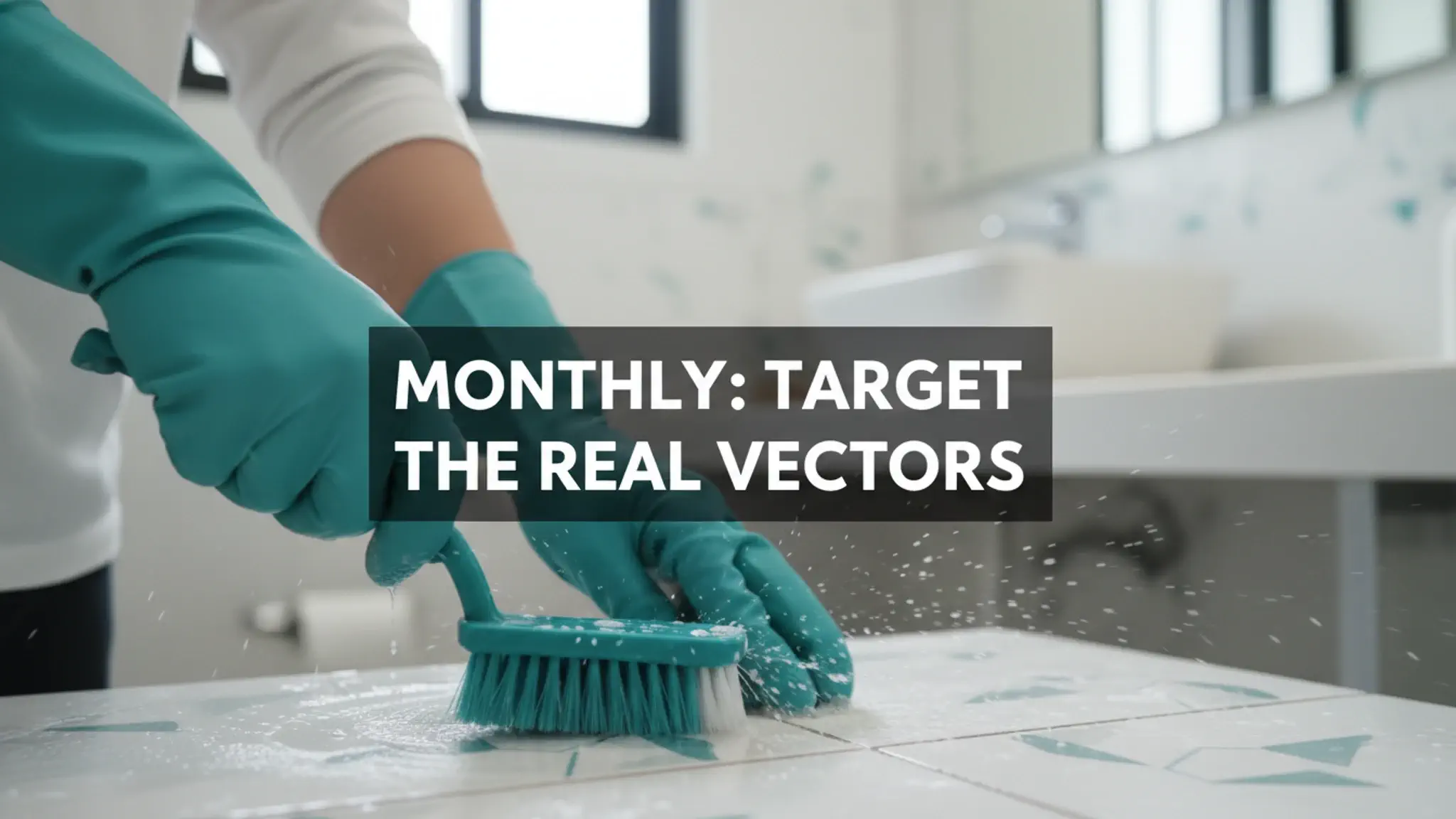
Monthly: High-Risk Zones That Need Attention Every 4 Weeks
These are the areas where bacteria, mold, and dengue breeding conditions build fastest. A monthly clean on these specific zones is more impactful than a weekly wipe of the whole flat.
Toilet base, cistern, and behind the bowl. The space between the base of a toilet and the floor traps urine splash, moisture, and hair. Bacteria concentrations here are among the highest in any home. Include the cistern exterior and the wall behind the bowl.
Kitchen grease zones. Cooker hood filter, stovetop gaps, and backsplash grout accumulate grease rapidly in Singapore kitchens. Grease is an organic food source for bacteria and mold. Monthly degreasing prevents compounding buildup that eventually requires professional intervention.
Bathroom grout and silicone seals. Grout is porous. In Singapore's humidity, mold spores settle in wet grout within days. Monthly scrubbing with a grout brush and mild anti-mold cleaner prevents the deep discolouration that requires professional mold removal treatment.
Children's bath toys and plastic toys. Hollow bath toys accumulate biofilm inside the cavity. Studies from 2018 (ETH Zurich and EAWAG) found fungal growth inside 58% of bath toys tested. Squeeze monthly over a drain, sanitise with diluted white vinegar, and discard toys that cannot be opened for cleaning.
Doorknobs, light switches, and TV remotes. These are the three highest-touch surfaces in any home. A damp cloth with general household cleaner once a week is sufficient for most periods. Once a month, clean thoroughly with a damp microfibre cloth, including the edges of switch plates.
Dish rack and kitchen sponge. The kitchen sponge is the most bacteria-dense object in most Singapore homes — denser than the toilet seat, per multiple microbiology studies. Replace every two weeks. The dish rack collects standing water; scrub monthly and dry fully.
Flower pot trays, pails, and standing water spots. Per NEA, stagnant water as small as a 20-cent coin is enough for Aedes mosquitoes to breed. NEA's B-L-O-C-K guidance specifically targets these: Break up hardened soil, Lift and empty flower pot plates, Overturn pails, Change water in vases, Keep gutters clear. Do a monthly indoor sweep of every container that could collect water. First-time offenders found with a single breeding habitat face a $200 composition fine. Multiple sites raise that to $300.
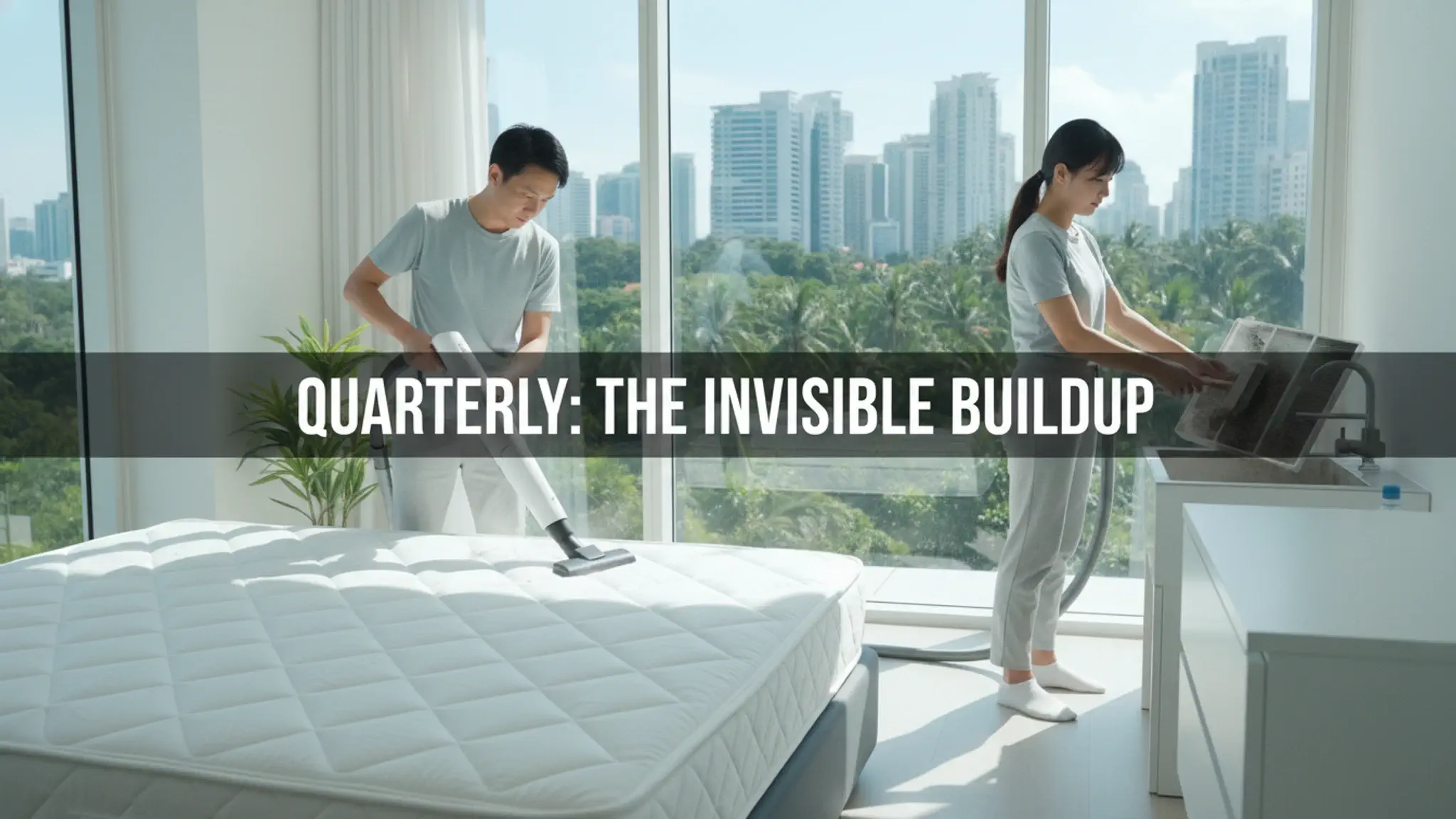
Quarterly: What Builds Up Slowly and Causes the Real Damage
These areas look fine from the outside. The buildup is invisible until it becomes a health problem.
Mattress. Dust mites reproduce every three weeks. In Singapore's humidity, a mattress that has not been cleaned for three months can harbour tens of thousands of mites per gram of dust. Dust mite allergens are the leading indoor trigger for asthma in Singapore children (MOH, ongoing reports). Vacuum both sides using a HEPA-filter vacuum or book a professional mattress clean.
Aircon filter. Dirty aircon filters do two things: they push mold spores and dust particles back into room air, and they reduce cooling efficiency by 20 to 30%. NEA recommends cleaning aircon filters at least every three months. In practice, many Singapore households run aircon daily — inspect filters every 6 to 8 weeks and clean quarterly at minimum. For deeper ducting work, professional aircon servicing addresses what filter cleaning cannot.
Inside the fridge, microwave, and oven. Bacteria from raw meat, spilled juices, and food residue accumulate in fridge door seals and crevices. The microwave interior — splattered food dried over multiple heating cycles — is a direct contamination vector. Clean all three interiors quarterly.
Sofa and upholstery. Sofas accumulate dust mite allergens, pet dander, and bacteria from daily use. Most Singapore households vacuum weekly, but upholstery requires a deeper extraction clean quarterly. This matters especially for homes with young children or anyone with respiratory sensitivities.
Behind the fridge and washing machine. These two spots combine dust accumulation, heat, and moisture — ideal for mold and cockroach activity. Pull both appliances out quarterly, clean behind and underneath, and dry the area.
Window tracks and frames. Water pools in window tracks after rain. In Singapore, this happens multiple times a week. Left alone, window tracks develop mold within weeks and can become a small Aedes breeding site if water stagnates. Dry and scrub quarterly.
Storeroom and under-bed storage. Closed, poorly ventilated spaces with stored items are high-risk for mold and silverfish. Quarterly, remove stored items, vacuum the floor, wipe down shelving, and check for moisture or musty odours.
Annual: The Full Reset Most Singapore Homes Skip
Once-a-year tasks that accumulate slowly enough to feel optional until they cause a visible problem.
Inside wardrobes and drawers. Wardrobes trap moisture from clothing, especially in Singapore's humidity. Silverfish are drawn to natural fibres, paper, and cardboard in dark, enclosed storage. Annually, empty all drawers and shelves, vacuum, wipe down, and allow to air dry fully before refilling.
Curtains. Hanging fabric acts as a long-term trap for dust, mold spores, and pollutants. Curtains in Singapore homes are rarely washed. Over 12 months, they accumulate enough particulate matter to affect air quality in enclosed rooms. Wash or dry-clean annually.
Ceiling fans. A single dirty ceiling fan redistributes months of accumulated dust in seconds every time it is switched on. The upper surface of each blade collects a dense mat of grease-bonded dust. Clean annually — or quarterly if the fan runs continuously.
Behind heavy furniture. The wall behind a sofa pushed against an exterior-facing wall is one of the most common hidden mold sites in Singapore HDB flats. Cool, poorly ventilated, and shaded — ideal conditions. Annually, pull heavy furniture forward and inspect. A 5 to 10 centimetre gap from the wall prevents moisture accumulation.
Formaldehyde from newer furniture. New flat-pack furniture and renovation materials off-gas formaldehyde and other VOCs for six to 12 months after installation. Newly renovated homes and BTO units benefit from an annual deep ventilation session: open all windows for several hours on a dry day, run fans, and clean all sealed surfaces with a damp wipe.
Grout re-sealing. If professional cleaning reveals grout that is too porous to scrub clean, re-sealing after deep cleaning prevents recurring mold penetration. This is an annual assessment rather than a fixed task.
What You Do Not Need to Obsess Over
The schedule above targets real health vectors. These are the things people over-clean, often with little benefit and some risk.
Daily floor disinfection. Floor bacteria pose minimal risk to adults and children who are not crawling. Weekly mopping with a standard floor cleaner is sufficient unless someone in the household is sick.
Hospital-grade disinfectants on food surfaces. Bleach and quart-strength disinfectants on kitchen counters leave chemical residue that is itself a health risk. Standard kitchen surface cleaner is appropriate. Reserve hospital-grade sanitising and disinfecting for post-illness situations or specific health requirements.
Washing walls weekly. Singapore walls do not require weekly washing. Monthly in kitchens, every two to three months elsewhere is sufficient for most households.
Running air purifiers 24 hours a day. Good airflow, regular aircon maintenance, and quarterly spring cleaning achieve more than an air purifier running continuously in a poorly cleaned room. An air purifier filters symptoms, not causes.
The goal is targeting the actual vectors — dengue breeding spots, mold growth zones, dust mite accumulation areas — not maintaining a surface appearance of cleanliness on everything.
Frequently Asked Questions
How often should you deep clean in Singapore? The practical cadence for Singapore is: monthly for high-risk zones (bathroom grout, kitchen grease, toilet base, stagnant water spots), quarterly for slow-buildup areas (mattress, aircon, sofa, behind appliances), and annually for full resets (curtains, wardrobes, ceiling fans, behind heavy furniture). The standard Western advice of twice-yearly deep cleans is not enough in Singapore's humidity.
What kills dengue mosquito larvae at home? Removing the standing water removes the larvae. Aedes mosquitoes breed in as little as a 20-cent coin's worth of stagnant water. BTI (Bacillus thuringiensis israelensis) insecticide granules can be placed in gutters and drains that hold water. Do not add bleach to drains — it disperses quickly and is not effective against Aedes breeding.
How do I prevent mold in my Singapore home? Control humidity first: keep indoor relative humidity below 60% using aircon dry mode or a dehumidifier. Clean bathroom grout monthly. Leave a 5 to 10 centimetre gap between large furniture and exterior walls. Service aircon filters quarterly. Fix any leaks within 24 hours — mold can establish in as little as 24 to 48 hours on a wet surface.
Is deep cleaning worth it if I clean regularly? Yes, for specific tasks. Regular cleaning maintains surface appearance. Professional deep cleaning addresses the areas a standard clean does not: grout scrubbing, mattress dust mite extraction, aircon ducting, behind appliances, inside wardrobes. In Singapore's humidity, the quarterly and annual resets are where professional service adds the most value.
What is the difference between sanitising and disinfecting? Sanitising reduces bacterial counts to safe levels. Disinfecting kills a broader spectrum of pathogens including viruses and fungi. Most household cleaning is sanitising — appropriate for daily and weekly use. Disinfecting is warranted after illness, post-renovation, or for specific health conditions. Using disinfectant daily on all surfaces is unnecessary and risks chemical exposure.
Why are aircon filters so important in Singapore? Singapore's humidity means aircon units run almost daily. Filters accumulate mold spores, dust mite allergens, and fine particulates rapidly. A dirty filter recirculates these directly into room air. More significantly, mold growing inside an aircon unit disperses spores every time the unit runs. Quarterly filter cleaning and annual professional servicing prevent this.
Three Rules. One Healthy Home.
The Rule of Thirds gives every Singapore household a practical framework. Monthly for bacteria and dengue vectors. Quarterly for slow-buildup health risks. Annual for the full reset.
The tasks that matter most are not the ones that look dirty — they are the ones that build invisibly: grout, mattresses, aircon filters, standing water, behind heavy furniture. These are where real health risks accumulate in Singapore's climate.
For the quarterly and annual tasks, professional deep cleaning is where the investment makes sense. EasyClean's professional team handles the tasks most households defer: mattress extraction, aircon servicing, mold treatment, grout scrubbing, and full-home deep resets.
Book a deep clean with EasyClean — pricing is confirmed before booking via WhatsApp.