

A confirmed HFMD case at your child's preschool. A colleague who tested positive last Friday. A flat handover after a sick tenant moved out. These are the moments people go looking for disinfection services in Singapore, usually in a rush and unsure what a fair price is.
This guide gives you the real cost ranges, the triggers that genuinely call for a professional job, and the times it is overkill. We run disinfection across HDB flats, offices, childcare centres and F&B outlets, so the numbers and rules here are the ones you will actually meet, not a pitch for fogging you may not need.
How much do disinfection services cost in Singapore?
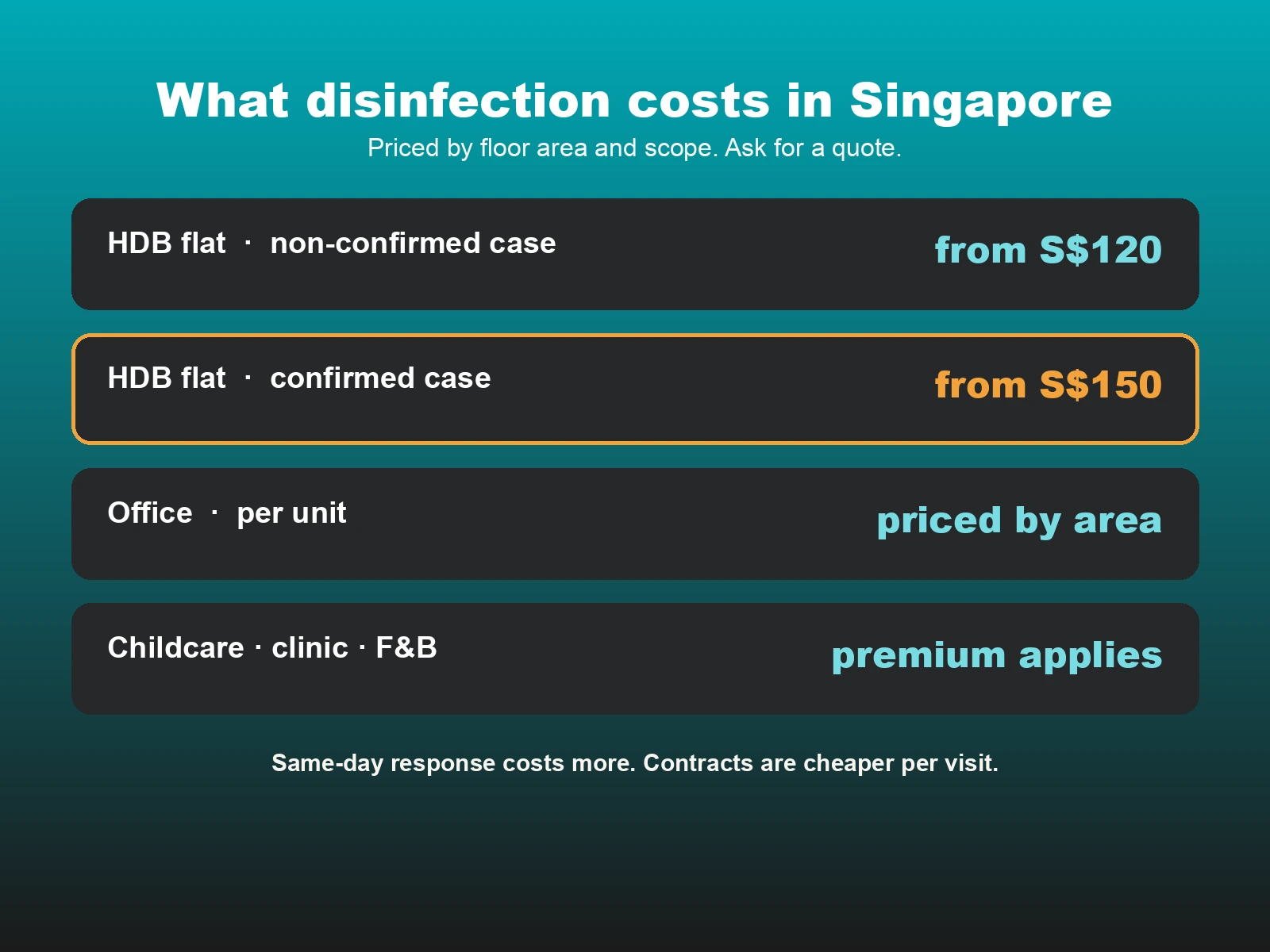
Quick Answer: A one-off home disinfection in Singapore starts from around S$120 for a standard HDB flat and is priced by floor area. Offices are quoted by area too, typically from a few hundred dollars per visit and higher for full floors. A confirmed infectious case costs more than a routine booking, and same-day response adds a surcharge.
Most home jobs are quoted by floor area, not room count. A common structure sets a base rate for the first 500 sqft, then a small add-on for each extra 100 sqft. On EasyClean's published rates, a non-confirmed booking starts from around S$120, and a confirmed case starts from around S$150. The final figure depends on your flat size, so treat these as starting points and ask for a quote.
The confirmed-case premium is not a markup for the sake of it. It pays for stricter protocols, a stronger dwell time, and full documentation you can hand to a landlord, insurer, or authority.
Offices are priced by area and scope, not by a single flat rate. A small unit typically starts from a few hundred dollars per visit, while larger floors run higher and are often quoted per square metre after a walk-through. Childcare centres, clinics and F&B outlets usually carry a premium for the extra product certification and material checks. Prices generally sit alongside the current 9 percent GST, and a recurring contract works out cheaper per visit than a one-off booking.
A few things push a quote higher. Same-day emergency slots for a confirmed case add a surcharge. Add-ons like HVAC vent disinfection or before-and-after ATP surface testing sit on top of the base job. A self-disinfecting coating on high-touch points is usually charged per surface. The honest read is simple: a routine home job stays near the starting rate, while an outbreak reset in a busy premises with documentation and add-ons costs a good deal more.
When you actually need it, and when it is overkill
Here is the part most provider pages skip. Disinfection is an event, not a habit. You book it when there is a real reason, then you go back to normal cleaning.
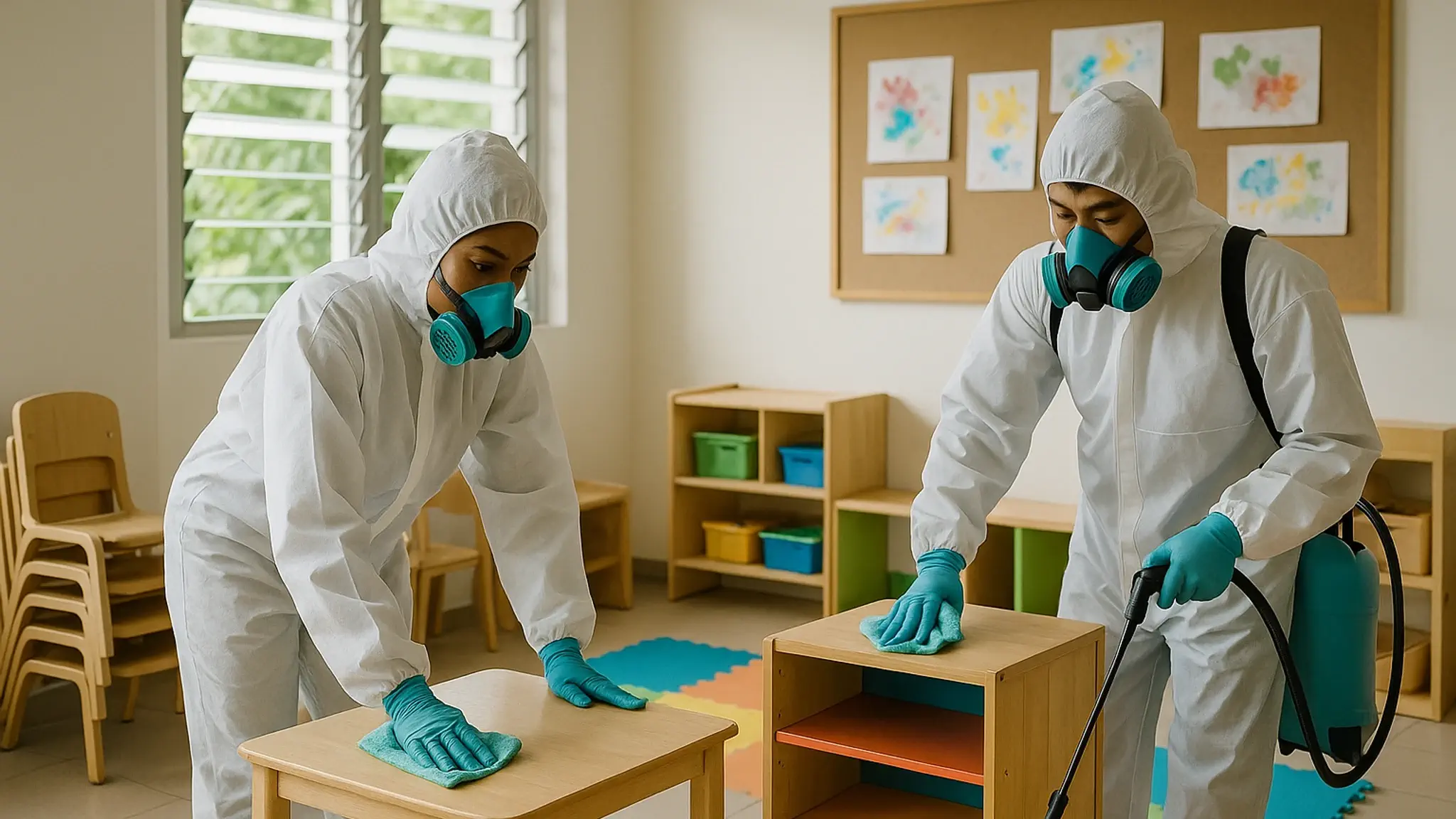
The clear triggers are worth paying for. A confirmed HFMD case at a childcare centre means high-touch surfaces and shared toys need a proper reset, often with documentation for ECDA notification. A positive COVID, flu, norovirus or RSV case in an office justifies a same-day job on desks, meeting rooms and washrooms. F&B outlets book it after a food-poisoning scare or for SFA and HACCP audit files. Post-tenancy handovers where someone was ill are another honest reason.
There is also a fair middle ground. A household with a newborn, an elderly relative, or someone on chemotherapy has a real case for a one-off disinfection after an illness passes through the home. So does a move-in where you do not know the last tenant's health, or a flat that has sat closed and damp for months. In those cases the point is peace of mind for a genuine vulnerability, not a standing subscription.
Now the overkill. Routine home fogging, booked monthly with no incident, is mostly marketing. For everyday home hygiene, wiping high-touch points with a suitable product does the job. The National Environment Agency's own advice is to clean first, then disinfect only when appropriate, using diluted bleach or an alcohol product with at least 70 percent alcohol. You can read the NEA guidelines for cleaning and disinfecting residences for the official position.
One more myth to kill. Dengue and chikungunya are spread by mosquitoes, not by surfaces. Surface disinfection does nothing for them. The real control is removing stagnant water and breeding sites. If a vendor sells you fogging as dengue protection, walk away. For the situations that do call for a professional job, see our disinfection services in Singapore.
Fogging, wipe-down, or a self-disinfecting coating
Three methods get used, and the right one depends on the job. Knowing the difference saves you money and stops you buying more than you need.
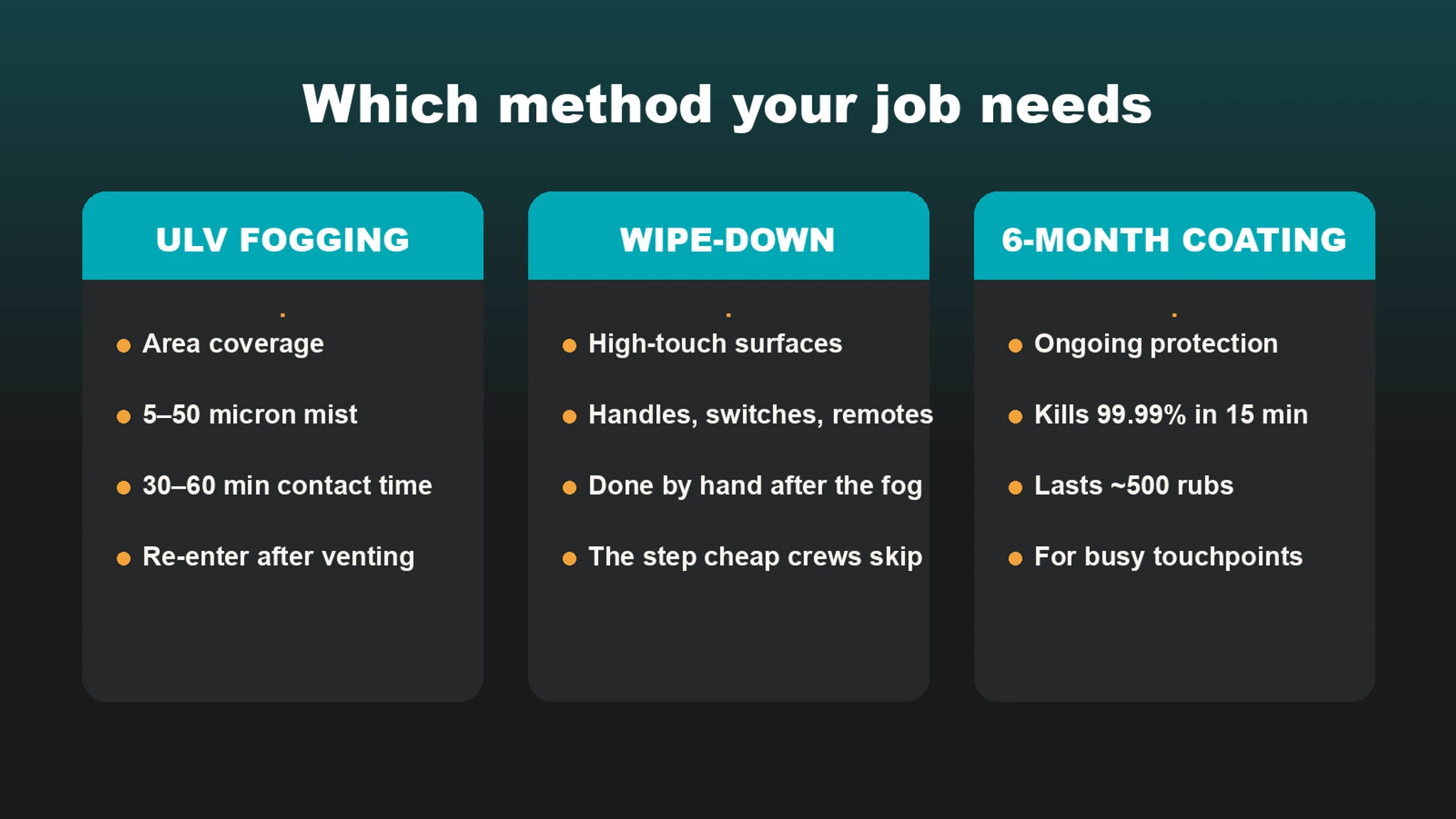
ULV fogging is the workhorse for area coverage. A cold fogger throws a fine mist of 5 to 50 micron droplets that settles on horizontal and reachable vertical surfaces, including the spots wiping misses. After a contact time of about 30 to 60 minutes and a short ventilation cycle, the space is safe to re-enter. Hard surfaces are usually dry within 10 to 30 minutes.
Manual wipe-down comes after the fog, on high-touch surfaces like door handles, switches and remotes. This is the step cheap providers skip. Fog alone does not scrub a greasy handle clean. A good crew uses an active ingredient effective against most viruses, applied by hand where it matters most.
A self-disinfecting coating is the longer play. It keeps working between deep cleans. A quality coating holds for up to 6 months, kills 99.99 percent of bacteria and viruses within 15 minutes of contact, and survives around 500 rubs without washing off during routine cleaning. It suits busy touchpoints in offices, clinics and childcare centres. See how it works on our self-disinfecting coating page. In our experience, the smart setup is a one-off fog and wipe after an incident, then a coating on the surfaces that get touched all day.
What "NEA-listed" actually means before you book
Vendors love the phrase "NEA-approved." It is often looser than it sounds, so know what you are checking.
NEA runs a Cleaning Business Licence for cleaning firms, and it publishes a list of disinfectant and surface-coating products shown to work against specific viruses. "NEA-listed" usually points to the product being on that list, not to NEA personally endorsing the company. Both matter, but they are different claims. Ask which one the vendor means.
The chemistry to look for in Singapore is a quaternary ammonium compound, commonly called QAC. It is the standard active for professional jobs and it is what most NEA-listed foggers carry. A serious crew also trains in infection control and follows a proper PPE routine, donning and doffing gear correctly so they do not spread what they are there to remove.
The last thing to demand is paperwork. For any confirmed case, or any childcare, clinic, office or F&B premises, you want a service report with photos, usually emailed within one working day. That report is what you file for ECDA, SFA, MOH or an insurer, and it is what lets you reopen with a clear record. If a provider cannot produce one, they are cleaning, not documenting. Browse the full range on our servicespage to see how disinfection fits alongside deep cleaning.
Frequently Asked Questions
How much does disinfection cost for an HDB flat in Singapore?
A one-off HDB disinfection starts from around S$120 on EasyClean's published rates and is priced by floor area. A common structure is a base rate for the first 500 sqft, then a small add-on per extra 100 sqft. A confirmed infectious case costs more than a routine booking because of stricter protocols and documentation.
Is disinfection the same as deep cleaning?
No. Cleaning removes dirt, grease and much of the germ load from a surface. Disinfection is a chemical step that kills the germs left behind. Best practice is to clean first, then disinfect only when there is a real reason, since dirt reduces how well a disinfectant works.
Do I need disinfection for dengue or chikungunya?
No. Both are spread by mosquitoes, not by surfaces, so surface disinfection does not help. The real control is removing stagnant water and mosquito breeding sites in and around your home. Any vendor selling fogging as dengue protection is misleading you.
How long before I can re-enter a room after fogging?
Usually 30 to 60 minutes, which covers the disinfectant contact time plus a short ventilation cycle. Hard surfaces are generally dry within 10 to 30 minutes. Offices and F&B outlets are often scheduled overnight so the space is ready before the next working day.
Does NEA require professional disinfection for offices or F&B?
NEA sets hygiene guidelines and licenses cleaning businesses, but it does not mandate routine third-party fogging for every premises. Professional disinfection is used for incident response, outbreak resets, and when a business needs a documented record for SFA, MOH or an audit file.
Book it when it counts, skip it when it doesn't
Three things to hold on to. Disinfection is an event with a real trigger, not a monthly habit. A confirmed case, a childcare or F&B reset, and a documented handover are worth paying for, while routine home fogging and anything sold as dengue protection are not. And the paperwork is half the value when you need to reopen or file a claim.
If you have a real reason to book, we will quote by your floor area and turn around a photo report within one working day. Call EasyClean at +65 8875 6486 or contact us and tell us what happened, and we will tell you honestly whether you need a full job or just a targeted one.
EasyClean | Disinfection Services | Singapore