

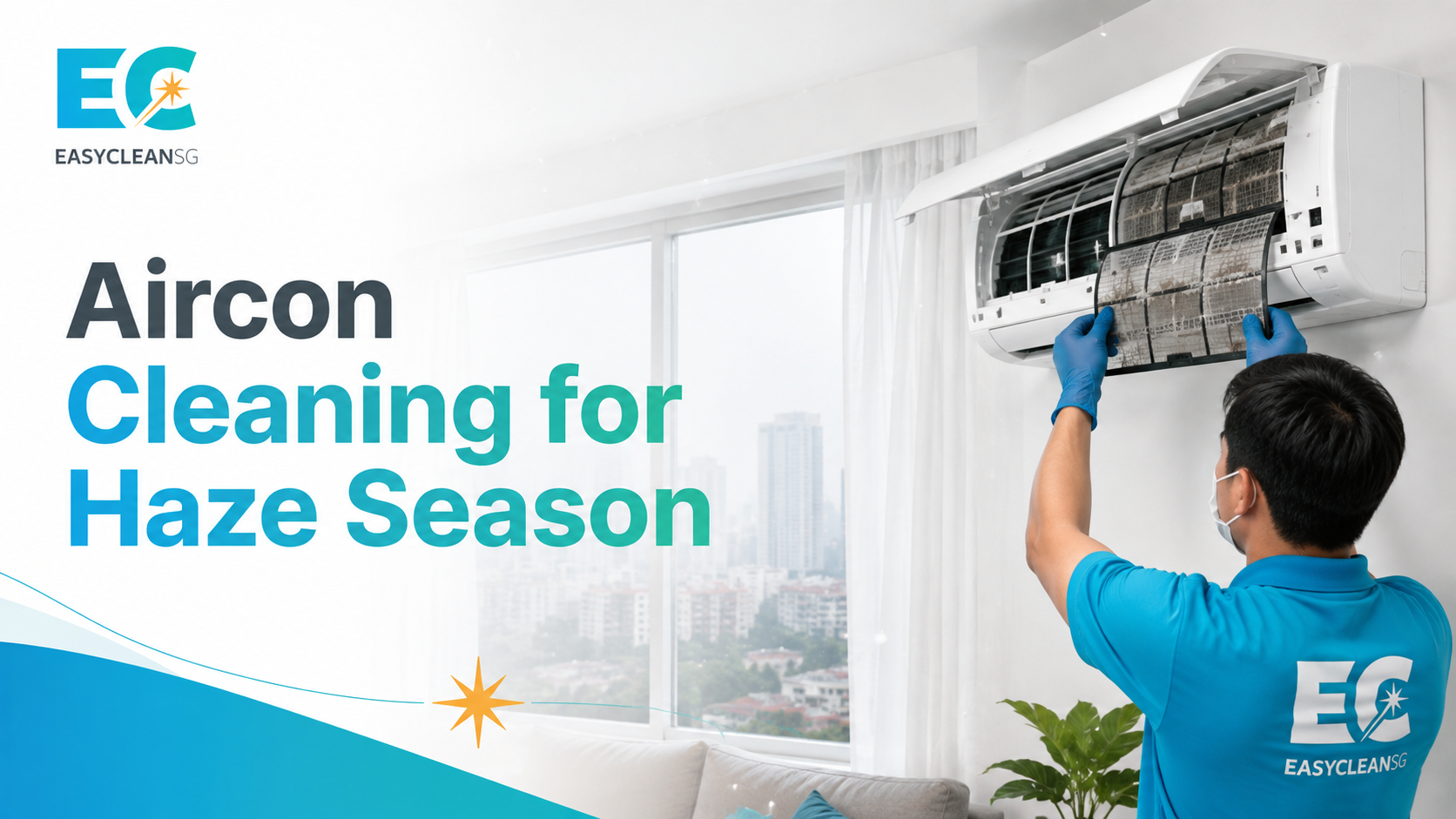
Here is the part most people get wrong. Your wall-mounted split aircon does not filter haze out of your home. It cools and recirculates the air already inside, so when fine haze particles seep in through gaps and window units, the unit just pushes them around a colder room. During haze season in Singapore, aircon cleaning and home disinfection are less about comfort and more about what you are breathing at home. This guide covers what actually reduces indoor PM2.5, when a chemical wash is worth it, real 2026 prices, and how disinfection fits in. No fluff, just what works in an HDB or condo.
Does aircon cleaning help during haze season?
Quick Answer: Aircon cleaning helps indirectly. A split aircon recirculates indoor air, so a clean coil and filter keep it running efficiently while you keep haze out by closing windows. A chemical wash costs $80 to $120 per unit in Singapore. For real PM2.5 reduction, pair a clean aircon with a HEPA air purifier and, in shared or high-touch homes, professional disinfection.
The National Environment Agency is direct on this point. Fine particulate matter, PM2.5, enters air-conditioned homes through fresh-air intakes, window-unit vents, and gaps, and it can build up indoors to unhealthy levels. NEA also notes that haze particles reduce the efficiency of air-conditioning systems. A coil already coated in dust and biofilm loses more airflow the moment haze adds to the load.
That is why timing matters. In our work across HDB flats and condos, the units that struggle most in September are the ones last serviced over a year ago. A clogged filter during a haze week means weaker cooling, a musty smell, and a system working harder for worse air. A clean unit will not scrub haze from the air, but it holds its cooling and keeps the filter doing the small job it can do. See EasyClean's aircon servicing scope for what a proper service covers.
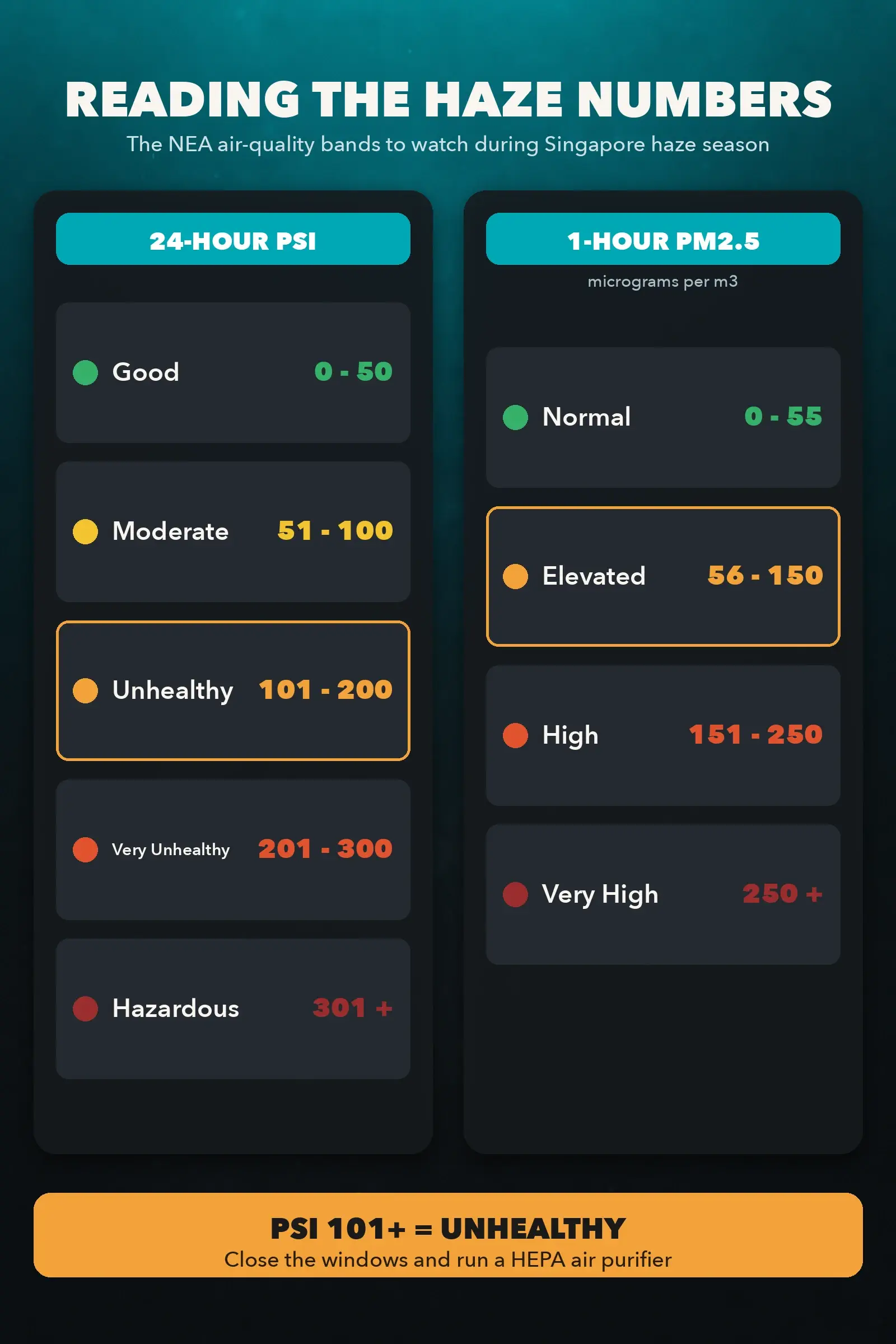
Haze in Singapore is seasonal, not year-round. NEA publishes a 24-hour PSI forecast during the Southwest Monsoon months, roughly August to October, when transboundary smoke from regional hotspots is most likely to drift in. A PSI reading of 101 and above is deemed unhealthy, and NEA reports 1-hour PM2.5 alongside it for short-term decisions. When the 1-hour PM2.5 sits in the Elevated band, 56 to 150 micrograms per cubic metre, that is your signal to shut windows and lean on cooling and filtration rather than natural ventilation. Servicing before that window, not during it, is the practical move.
What NEA says to do indoors during haze
NEA and the haze.gov.sg guidance give a clear indoor checklist, and most cleaning blogs skip it. Close doors and windows when outdoor air worsens. Reduce indoor pollution sources like candles and cigarettes. Use wet-cleaning, mopping and wiping, instead of dry-dusting or vacuuming, because dry methods stir settled particles back into the air.
On aircon specifically, NEA is precise. Fans or aircon may run for circulation and cooling. If your unit is a window type that draws unfiltered outdoor air, close the outdoor air intake. For homes wanting real filtration, NEA points to portable air purifiers with a HEPA filter, sized so the smoke CADR is at least three times the room volume in cubic metres.
There is a spec worth knowing. For fan-filter systems, NEA references a MERV 13 or F7 filter, the ASHRAE rating that removes at least 90% of particles in the 1 to 3 micron range. A standard aircon filter does not reach this. That is the honest limit of any aircon during haze, and it is why we tell clients the aircon and the purifier do different jobs. The full NEA managing-haze guidance is the reference to bookmark.
A quick note on the trade-off. A sealed flat traps more than haze. Heat, carbon dioxide, and cooking fumes build up in a closed room, so NEA suggests reopening windows briefly when the outdoor air improves. A running aircon manages the heat side of that problem while the windows stay shut, which is one more reason a unit that cools well through a haze week is worth having serviced early. Pair it with a purifier for the particles the aircon cannot catch, and you cover both sides.
Chemical wash or general service: what haze season needs
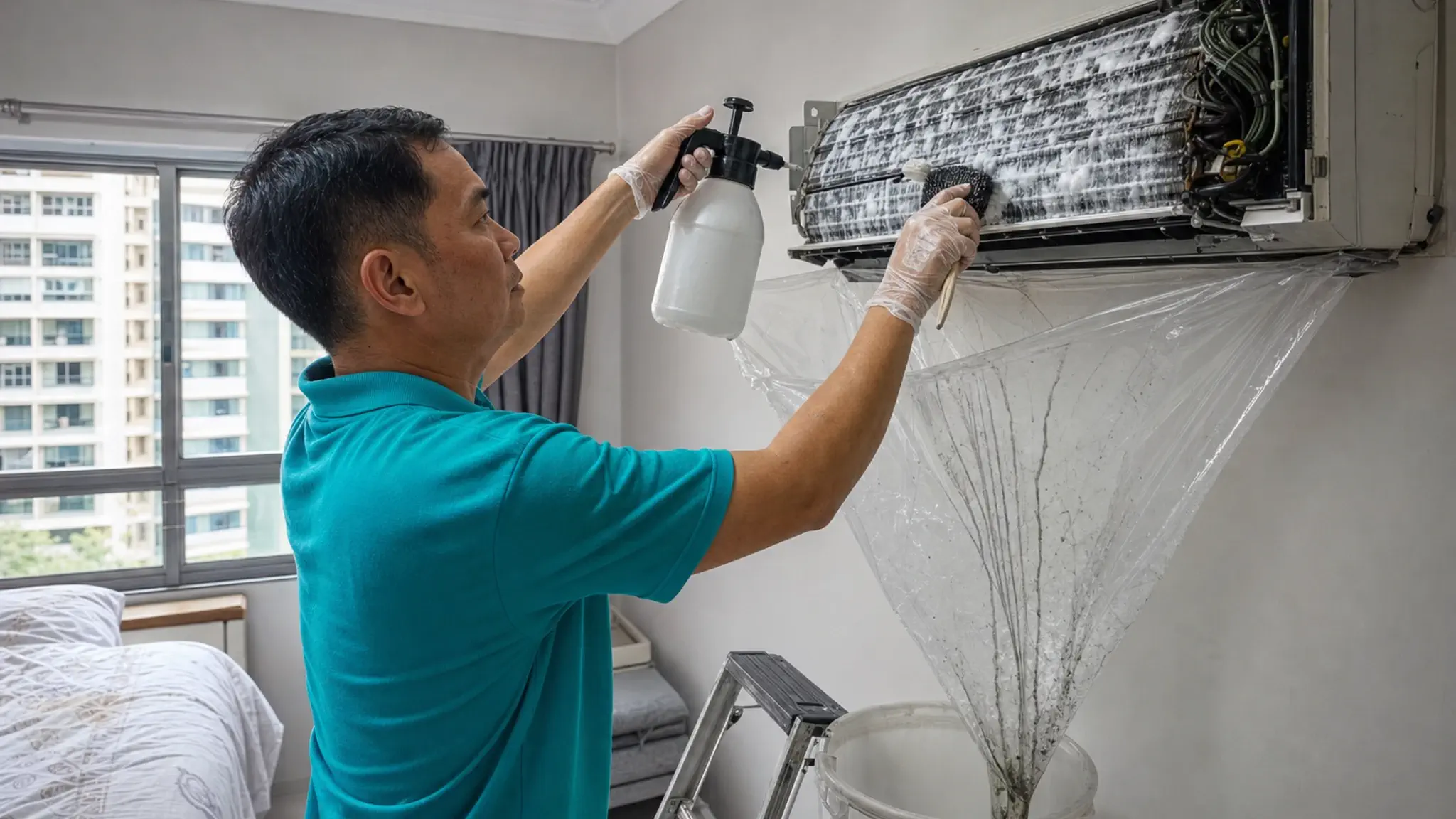
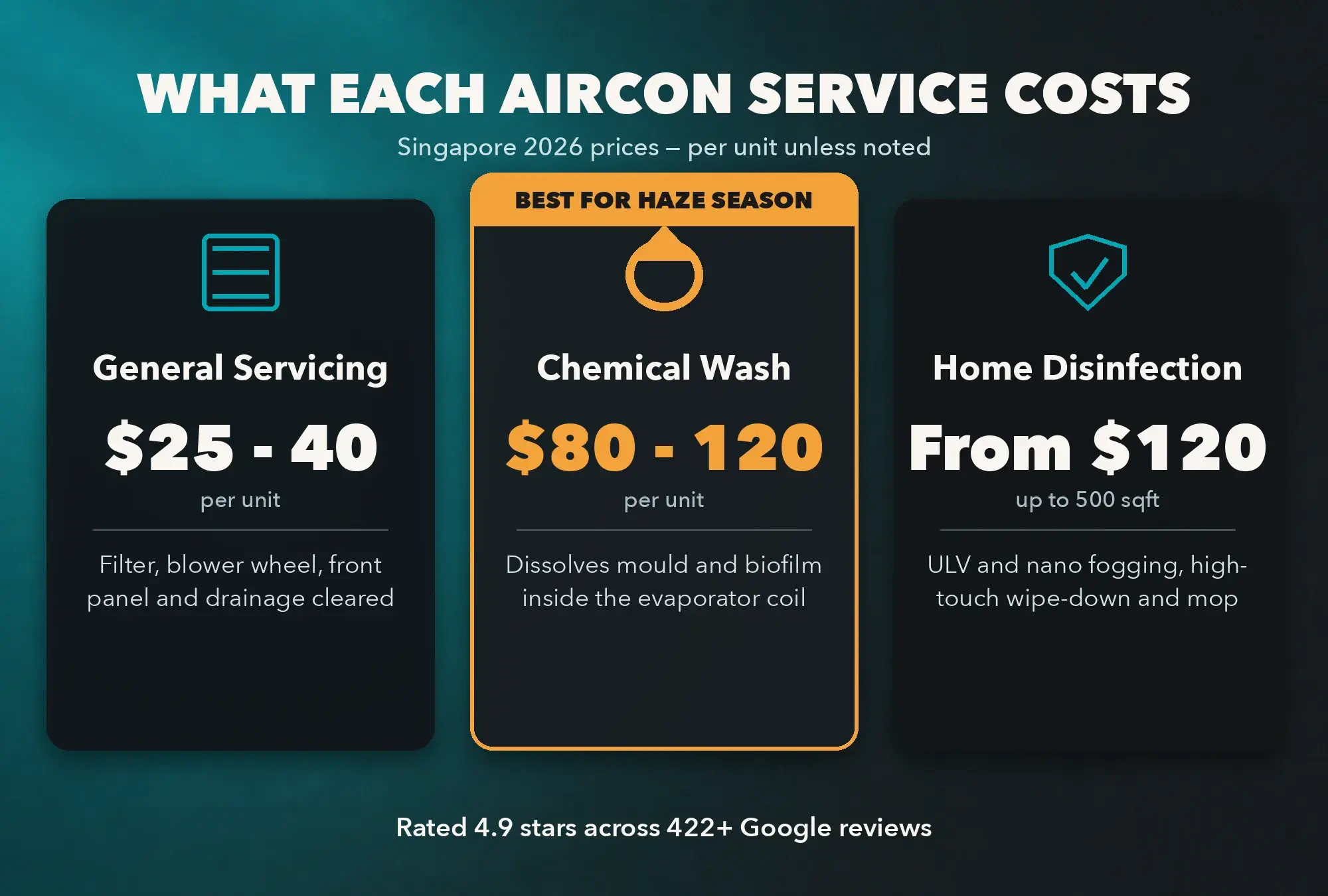
A general service and a chemical wash are not the same job. General servicing cleans the filter, blower wheel, front panel, and clears the drainage so the unit does not drip. A chemical wash goes further, applying solution to dissolve the mould and biofilm inside the evaporator coil that a routine service cannot shift.
For haze season, the deciding factor is smell and airflow. If your aircon still smells musty or cools weakly after a general service, the coil is fouled and a chemical wash is the next step. Helpling's 2026 breakdown puts a wall-mounted chemical wash at $80 to $120 per unit, rising to $120 to $150 for ceiling cassettes. A full chemical overhaul, where the unit is dismantled part by part, runs $150 to $250 per unit and is reserved for units untouched for two to three years.
What we tell families with young children, elderly members, or allergy sufferers: run quarterly general servicing and a chemical wash every 6 to 12 months. That cadence keeps airflow strong through the haze window without overspending. If you are unsure how often your setup needs it, EasyClean's guide on how often to service your aircon breaks it down by usage.
How do you know the coil is due for a wash and not just a service? Three signs show up together. The air smells damp or sour when the unit first switches on, cooling takes noticeably longer to reach the set temperature, and the fins look grey rather than metallic when you slide the filter out. Any two of those, and a general service alone will not fix it. During haze weeks the aircon runs longer hours with the windows shut, so a coil that was borderline in July often tips over the line by September. Booking the wash before that happens is cheaper than an emergency call-out mid-haze, when demand and wait times both climb.
Where home disinfection fits in
Haze rarely arrives alone. The same closed-window, low-ventilation weeks that trap PM2.5 also let viruses and surface germs linger. That is where a disinfection service earns its place, especially in homes with a helper, shared bedrooms, or someone recovering from illness.
A professional disinfection is not a spray-and-go. EasyClean's process runs ULV cold fogging and handheld nano fogging to reach hard corners, a wipe-down of high-touch surfaces with NEA-recommended disinfectant, and a final mop. Pricing starts at $120 for 500 sqft and below, then $20 per additional 100 sqft, with a photo service report sent within one working day. See the disinfection service page for coverage.
The wipe-down and mop matter as much as the fog. NEA's own haze tip is to wet-clean settled dust rather than dry-dust it, so a service that finishes with wiped surfaces and mopped floors also lifts the fine particles that drifted in and settled while the windows were shut. For a typical three-room HDB flat around 700 sqft, that works out to roughly $160 all in, less than a single ceiling-cassette chemical wash, and it resets the whole home in one visit.
For families who want longer protection, a self-disinfecting coating keeps treated surfaces active between visits. Rated 4.9 stars across 422+ reviews, our teams run this alongside aircon work so the whole home is handled in one booking rather than two.
Sequence matters if you are booking both. Do the aircon chemical wash first, then the disinfection fog and wipe-down. A wash kicks up dust and coil grime as the technician works, so disinfecting afterward captures that disturbed layer instead of leaving it to settle overnight. Homes with a domestic helper, shared bedrooms, or a recent bout of flu benefit most, since those are the spaces where surface germs and trapped particles overlap during a low-ventilation haze week. One visit, right order, and the home resets cleanly.
Frequently asked questions
Does running the aircon help with haze?
It helps with comfort, not filtration. A split aircon recirculates indoor air rather than filtering outdoor haze, so keep windows shut and add a HEPA purifier for actual PM2.5 removal. If you have a window unit that draws outside air, close its outdoor air intake, as NEA advises.
How much does an aircon chemical wash cost in Singapore?
A chemical wash runs $80 to $120 per unit for wall-mounted splits in 2026, with ceiling cassettes costing more. A full chemical overhaul is $150 to $250 per unit. Multi-unit bookings lower the per-unit rate since the technician is already on site.
Should I service my aircon before or during haze season?
Before, ideally. Book servicing in August as the Southwest Monsoon raises haze risk, so your units enter the peak with clean coils and clear drainage. A clogged unit during a haze week cools worse and works harder for lower-quality air.
Is disinfection worth it during haze?
For homes with a helper, young children, elderly members, or recent illness, yes. Low-ventilation weeks let germs linger longer indoors. Professional fogging with NEA-recommended disinfectant, from $120 for up to 500 sqft, pairs well with an aircon clean for a single-visit reset.
Get your home ready before the next PSI spike
Three things carry the load during haze season. Keep windows shut and add a HEPA purifier for real PM2.5 reduction, service or chemical-wash your aircon so it stays efficient, and disinfect if your home is shared or high-touch. The aircon and the purifier do different jobs, so treat them as a pair, not a substitute.
Want it handled in one visit? Book an aircon service and home disinfection together with EasyClean and go into the next haze week with a home that is clean, cool, and ready.