

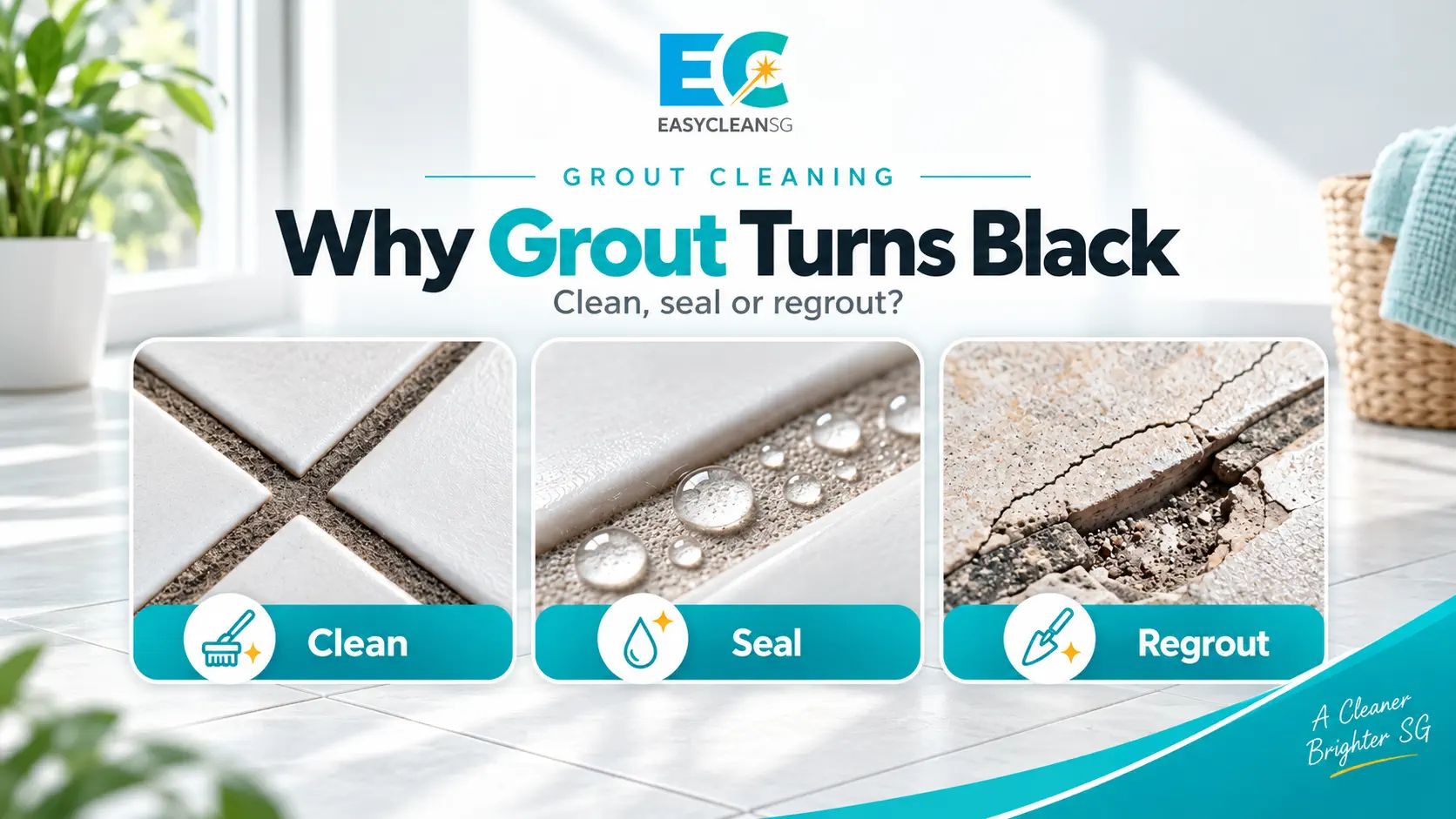
Your tiles look clean, but the lines between them have gone grey, brown or black. That is the most common complaint we hear about tiled floors in Singapore, and scrubbing harder rarely fixes it.
Grout cleaning works best when you know what you are cleaning. The black in your toilet is usually a different problem from the grey in your living room or the brown in your kitchen, and each one needs a different fix. This guide explains why grout turns black in Singapore homes, how to tell mould from dirt in 10 minutes, how our crew restores grout with steam, what it costs for an HDB flat, and when cleaning is no longer enough.
Why does grout turn black in Singapore homes?
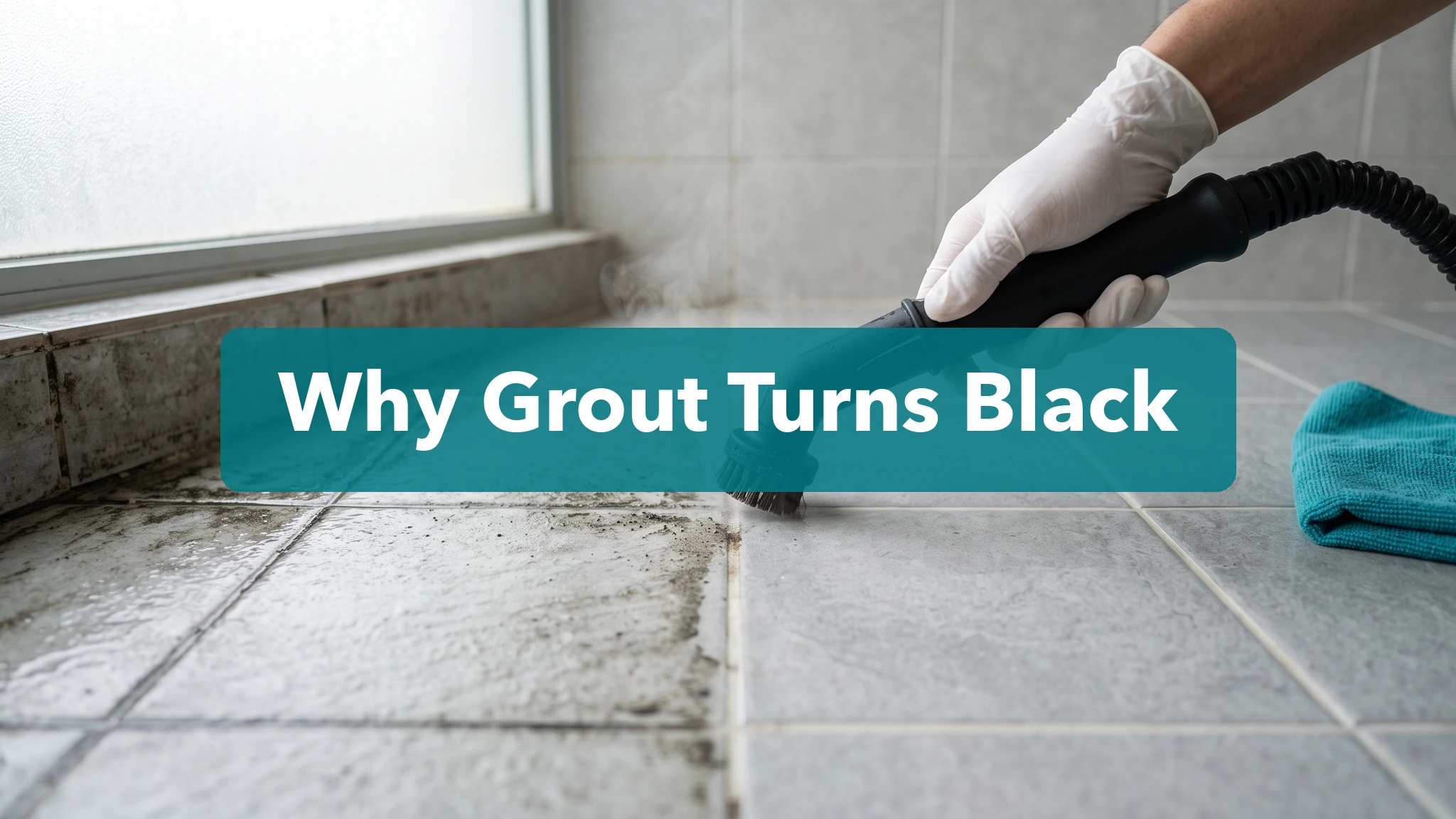
Quick Answer: Grout turns black because cement grout is porous. It soaks up dirty mop water, soap scum, skin oils and cooking grease, and in Singapore's damp air it rarely dries out, so mould can grow in it too. Most dark grout in living areas is trapped dirt, not mould. A professional grout cleaning with hot steam and scrubbing lifts most of it.
Grout is the cement-based filler between your tiles. It looks solid, but it behaves like a hard sponge. Our own grout deck puts it simply: grout is very porous, so it absorbs dirt, spills and stains, and if they stay long enough they can become permanent.
Singapore makes this worse. The Meteorological Service Singapore puts the mean annual relative humidity at around 82%, rising above 90% before sunrise and often hitting 100% during long spells of rain. Grout in a closed HDB toilet stays damp for hours after every shower.
Then there is the mop. Grout sits slightly lower than the tile. Every pass of a damp mop drains a little dirty water into those lines, and the water dries there while the tile surface dries clean. Mop daily with the same bucket and you are slowly dyeing your grout grey.
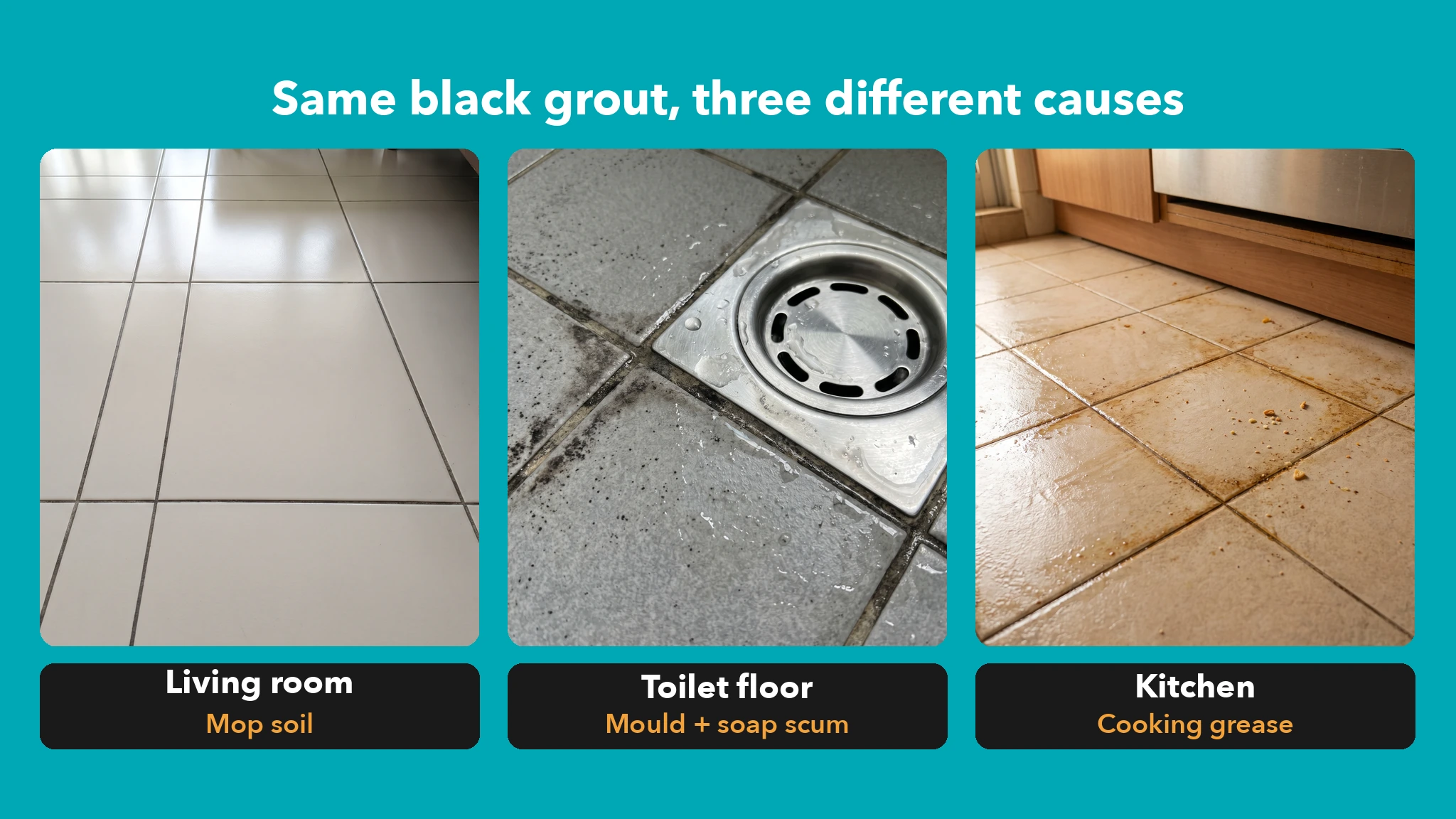
In our experience, the room tells you most of the story:
| Where the grout is dark | Most likely cause | What usually fixes it |
|---|---|---|
| Living room, bedrooms, corridor | Soil from mop water, foot traffic and dust | Steam and scrub, then change how you mop |
| Toilet floor and shower area | Mould and mildew, plus soap scum and body oils | Steam to kill and lift it, then better drying and ventilation |
| Kitchen floor and backsplash | Cooking grease that traps dust | Steam and scrub, with degreasing on the worst spots |
| Lines that stay dark after any cleaning | Permanent staining, or grout that is breaking down | Sealing, colour restoration or regrouting |
Is it mould or dirt? A 10-minute test
You can check before you book anything. Mix about 1 part household bleach with 10 parts water. Dab a little on one dark grout line in a hidden corner, wait 5 to 10 minutes, then rinse with clean water.
- It lightens quickly: the dark colour is mostly organic, which usually means mould or mildew. Expect it back if the room stays wet.
- It barely changes: the colour is dirt, grease or mineral staining packed into the pores. Bleach will not lift it. Heat, agitation and extraction will.
Keep the windows open, and never mix bleach with vinegar, ammonia or other cleaners. Coloured grout can fade, so test somewhere nobody looks. This is a screening test only, not a lab result.
Bleach is a poor way to clean grout, even when the test says mould. It whitens the surface for a while but leaves soil in the pores, and repeated use can weaken grout and wear down any sealer. Use it to diagnose, not as your weekly cleaner.
If the black is spreading beyond the grout, onto silicone, ceilings or walls, that is a wider moisture problem. Our mould removal treatment covers those surfaces.
How do professionals restore grout?
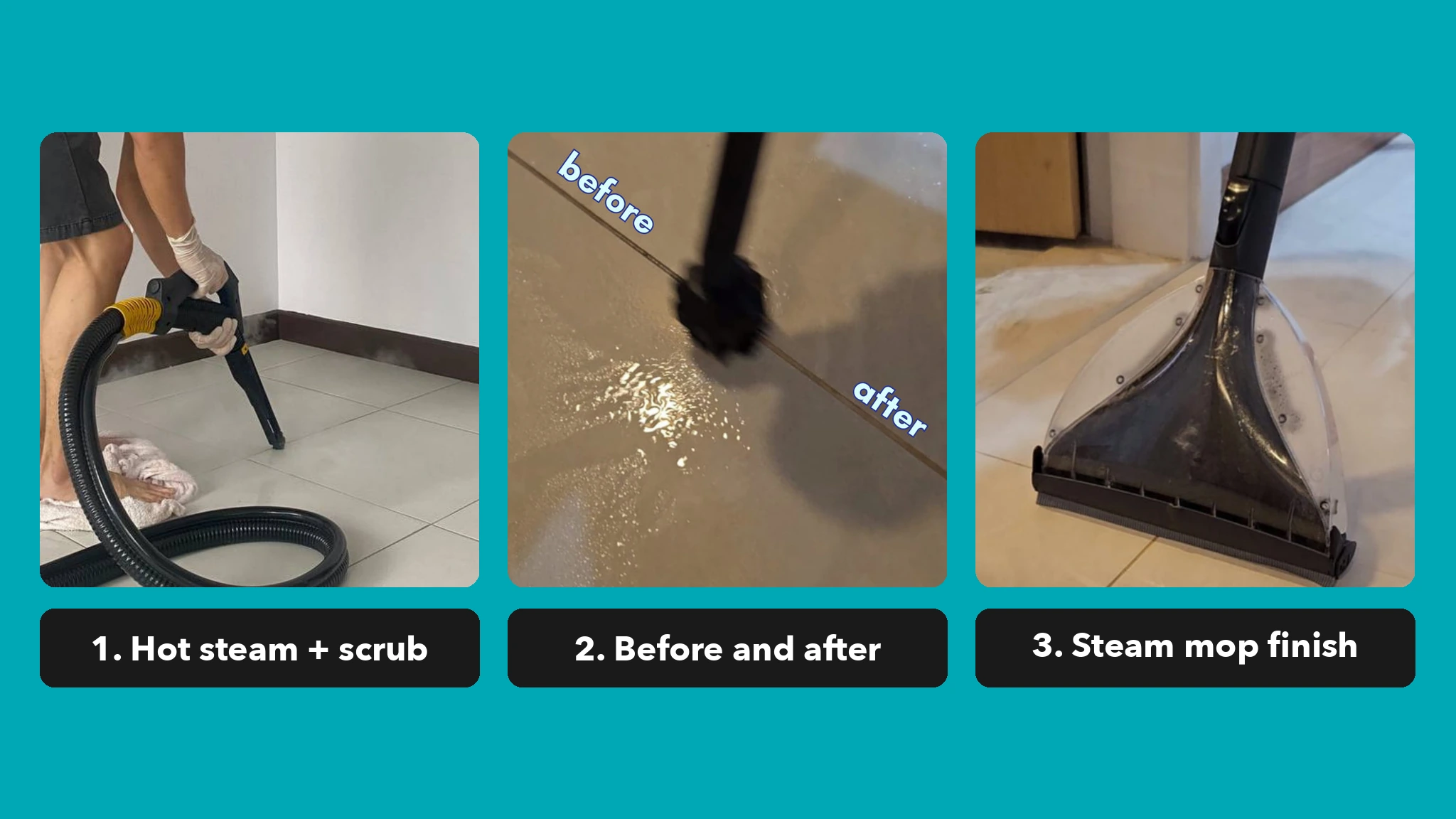
A pro job swaps scrubbing strength for heat, the right pressure and proper water removal. This is how our crew runs a grout cleaning job:
- Hot steam on every grout line. We use steam of up to 160°C, paired with the right pressure and scrubbing technique. The heat loosens soil and grease inside the pores and sanitises as it goes.
- Scrub and lift. Agitation breaks up what the steam has softened, so it can be removed instead of pushed deeper.
- Steam mop to finish. We steam mop the floor to clear the loosened debris and dirty water left by the grout cleaning, and to sanitise the tiles as well as the lines.
Because steam does the work, no acid touches your grout. Acidic cleaners, vinegar included, can eat into cement grout over time, so we keep them off it.
A few honest limits, straight from our price list. Stain removal is on a best effort basis, so grout that has been absorbing stains for a decade may lighten without coming back to its original shade. We do not remove hard stains such as adhesive, cement, glue or paint. We do not shift furniture, and no contractor or renovation work can happen during the cleaning. If you have just renovated, book your post-renovation cleaning first and the grout cleaning after the works are done.
How much does grout cleaning cost in Singapore?
Our grout cleaning is priced by the tiled area. The base price starts at about $180 for up to 500 sqft, then about $25 for each extra 100 sqft. Area is rounded up to the next 100 sqft block, so 779 sqft is charged as 800 sqft.
Here is what that works out to for typical flat sizes, counting tiled floor only:
| Area cleaned | Typical size | Estimated price |
|---|---|---|
| Kitchen and toilets only | under 500 sqft | from about $180 |
| 3-room HDB, all rooms tiled | about 650 to 750 sqft | about $230 to $260 |
| 4-room HDB, all rooms tiled | about 900 to 1,000 sqft | about $280 to $310 |
| 5-room HDB, all rooms tiled | about 1,100 to 1,200 sqft | about $330 to $360 |
As a worked example from our own price list, a 1,086 sqft HDB flat with every room tiled rounds up to 1,100 sqft and comes to about $330. A 400 sqft kitchen on its own stays at the base price.
If your bedrooms have vinyl or parquet, only the tiled areas count, which brings the price down. Not sure of your size? Send us your flat type and a few photos and we will work it out. The full price list is on our specialized cleaning services page.
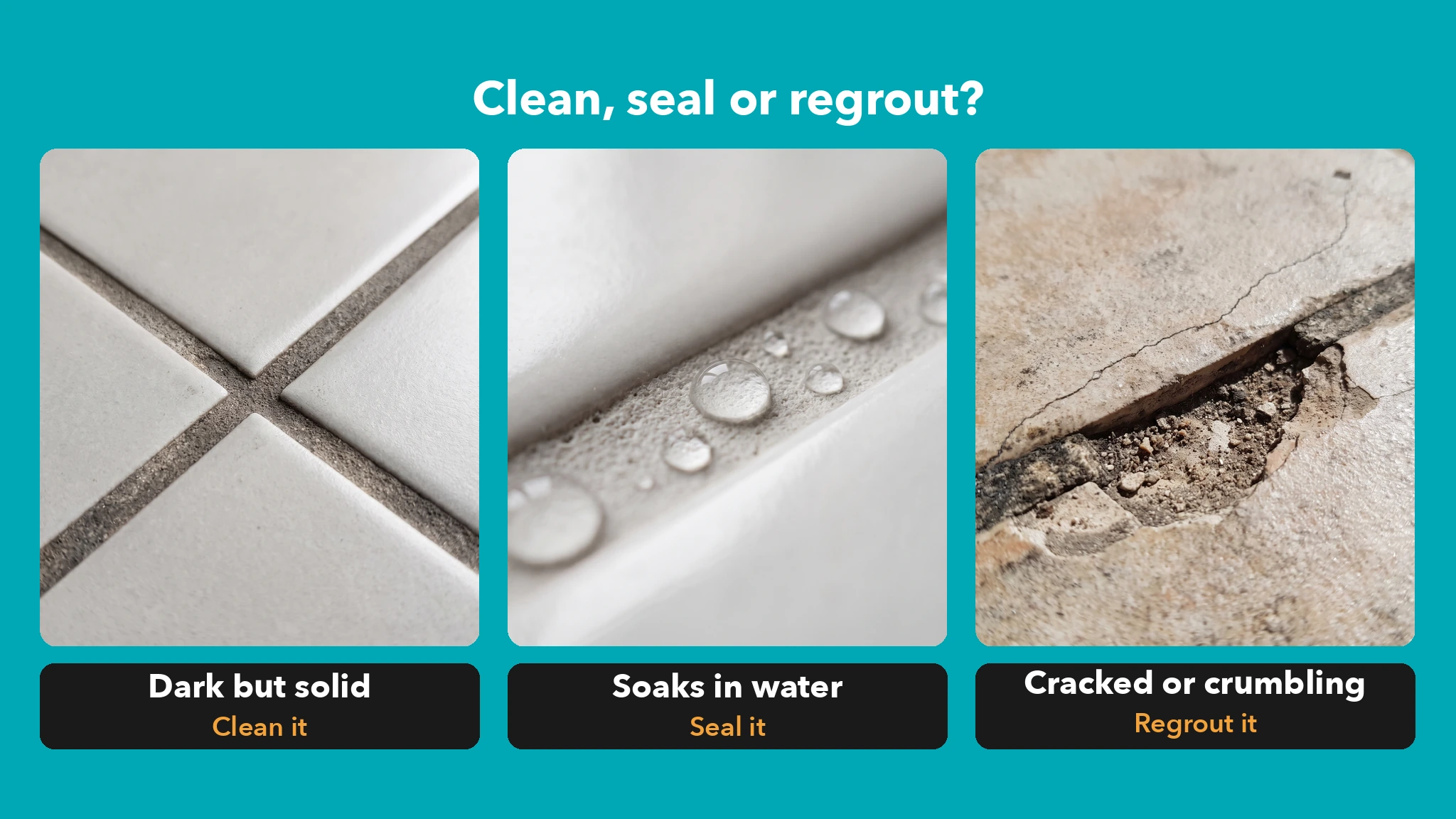
Cement vs epoxy grout: clean, seal or regrout?
Most standard tiling in Singapore homes uses cement grout, unless an owner has upgraded. That is the porous kind this article is about. Epoxy grout is made from resin and hardener instead, and it cures into a dense, non-porous line that water and stains struggle to get into. It costs more to install, but it rarely turns black the way cement grout does.
Not sure which you have? Drip a little water on a clean, dry grout line. If it darkens and soaks in within a minute, it is cement grout, or cement grout whose sealer has worn off. If the water beads and sits on top, it is sealed or epoxy.
Here is how we would decide what your grout needs:
- Clean it when the grout is dark but solid. Run a key or coin along the line. If nothing crumbles, cleaning will bring most of it back.
- Seal it after a deep clean if the water test shows it soaking in. A penetrating grout sealer slows down how fast dirt and moisture get back in. In wet areas like shower floors, plan to redo the water test every year or so.
- Regrout it when the lines are cracked, powdery, missing, or still dark after a professional clean. That is a tiling job. Many owners switch to epoxy at this point for toilets and kitchens.
We would not regrout grout that is only stained. Regrouting a whole HDB toilet costs far more than a clean, involves chipping out the old lines, and the new cement grout will darken again within a year or two if the room stays wet and the mop stays dirty. Clean first, then decide.
How to keep grout white after a clean
Most re-darkening comes from daily habits, not from the cleaning. These are the small changes we see working in HDB flats and condos:
- Change the mop water often, and rinse the mop head properly. A flat microfibre mop that you rinse after each room puts far less dirty water into the grout than a string mop and one bucket.
- Squeegee the shower floor after the last shower of the day, so the grout is not sitting in water overnight.
- Run the exhaust fan or leave the toilet door open for 15 to 20 minutes after showering, so the room can dry.
- Use a pH-neutral floor cleaner. Skip vinegar, and save bleach for spot treatment.
- Wipe kitchen spills the same day, especially oil near the stove.
For the right method on other floor types in your home, see our guide to floor cleaning by type.
Frequently Asked Questions
How much does grout cleaning cost in Singapore?
At EasyClean, grout cleaning starts from about $180 for up to 500 sqft of tiled area, plus about $25 for each extra 100 sqft. A fully tiled 4-room HDB flat usually comes to about $280 to $310.
Is professional grout cleaning worth it?
It is worth it when the grout is dark but still solid. Steam and scrubbing reach into the pores in a way a household brush cannot, and the job costs far less than regrouting. If the grout is cracked or crumbling, spend the money on regrouting instead.
Do steam cleaners destroy grout?
Steam does not harm grout that is sound and fully cured, and it avoids the acids and harsh chemicals that do. It can loosen grout that is already cracked or powdery, which is why we check the condition of your grout before we start.
Can vinegar ruin grout?
Yes, over time. Vinegar is an acid, and repeated use can wear down cement grout and strip any sealer on it. Use a pH-neutral cleaner for routine mopping.
Is it better to clean grout or regrout?
Clean first. If the grout is intact, a deep clean usually brings most of the colour back. Regrout only when the lines are cracked, crumbling or still dark after a professional clean.
Why is the grout around my toilet bowl dark?
Usually a mix of moisture, splashes and mould, since that area stays damp. Try the bleach spot test. If it lightens, it is organic and needs regular drying. If it does not, the staining has soaked into the grout and needs a deep clean or regrouting.
The short version
In most Singapore homes, black grout comes from porous cement soaking up mop water, grease and moisture, year after year. Test it first, clean it with heat rather than acid, seal it if it soaks in water, and only regrout when it is actually broken.
EasyClean SG holds a 4.9-star rating from more than 422 Google reviews. Send us your flat type and a photo of your grout through our contact page or call +65 8875 6486, and we will tell you whether it needs a clean, a seal or a tiler.
EasyClean | Specialized Cleaning | Singapore